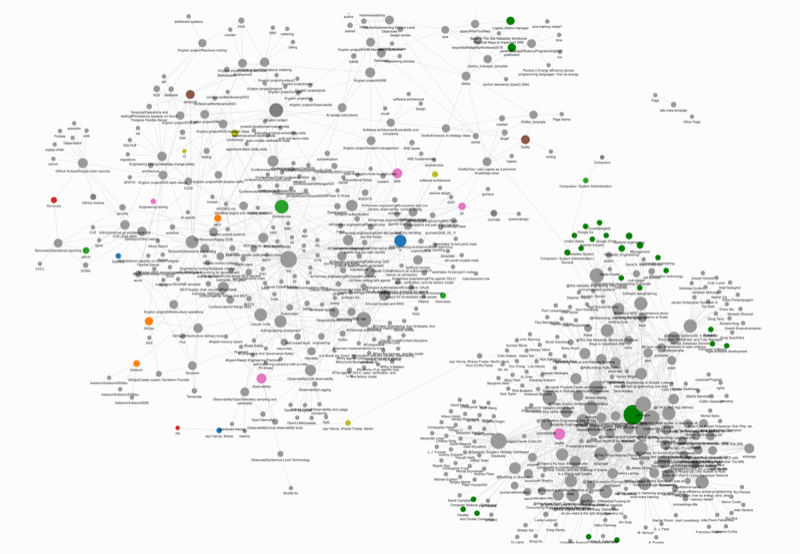
How I Use Logseq as a Personal Knowledge Base
How I use Logseq journals, local sources, durable pages, and agent-assisted curation to keep a personal knowledge base useful without turning every note into permanent documentation.
This setup was inspired by Andrej Karpathy’s LLM Wiki, but my version is deliberately local and boring: Logseq journals as the inbox, source files as the archive, and compact pages as the durable layer.
Google is making a similar argument with Open Knowledge Format: Markdown plus YAML front matter as a shareable knowledge format. I think the format is the easy part. Markdown, reStructuredText, AsciiDoc, or any plain text format with metadata can work. For company-wide use, the harder part is the documentation pipeline: how you ingest sources from different places, keep them fresh, and assign curators, human or LLM, to maintain the useful layer.
My Logseq graph is not where every thought becomes permanent. It is where raw material waits until I decide whether it deserves a second life.
The split in this repository is blunt:
journals/is the raw inbox.sources/is where bulky external material lives.pages/is the durable knowledge layer.log.mdis the audit trail of curation work.
Day to day, that is not formal. I capture links, screenshots, meeting fragments, commands, papers, talks, and half-formed notes into Logseq journals. Later, I run a curation pass and promote only the material I expect to search for again.
The flow
flowchart TD
  A[Daily capture in Logseq journals] --> B{Worth keeping?}
  B -- no --> C[Leave raw: TODOs, logistics, fragments]
  B -- yes --> D[Read surrounding journal context]

  E[Articles, docs, papers] --> F[Fetch and summarize]
  G[Videos and talks] --> H[yt-dlp subtitles into sources/transcripts]
  I[X.com threads] --> J[Local markdown exports in sources/x-com-posts]
  K[Images, PDFs, CSVs] --> L[assets/]
  M[Zotero exports] --> N[zoteroExport.bib / zoteroExport.json]

  F --> D
  H --> D
  J --> D
  L --> D
  N --> D

  D --> W[Run curate-journals skill]
  W --> O{Existing topic page?}
  O -- yes --> P["Update pages/topic.md"]
  O -- no --> Q[Create a durable page]

  P --> R[Summary, operational notes, gotchas, links, source notes]
  Q --> R
  R --> S["Cross-link with Logseq pages"]
  S --> T[Useful to Logseq, Codex, Claude Code, and future me]

  R --> U[Update log.md]
  U --> V[Processed journals, pages changed, links fetched, skipped items, backlog]
Journals are the inbox
Daily journals are intentionally messy. They contain:
- links I may or may not read later
- meeting scraps
- debugging notes
- command fragments
- screenshots
- TODOs
- short observations
- notes for work projects
I do not try to make journals beautiful. If I had to polish every note at capture time, I would capture less.
The rule is that journals are source material, not the knowledge base. Most journal bullets should never be promoted. TODO-only items, meeting logistics, unexplained fragments, and one-off status updates usually stay where they are.
What gets promoted is the material with reuse value:
- architecture decisions
- operational patterns
- incident/debugging lessons
- recurring themes
- commands with explanation
- glossary terms
- papers, talks, docs, and articles worth finding again
External sources need a local copy
Some source material is too large, too valuable, or too likely to disappear
behind a login wall. The graph has a sources/ directory for that.
For conference talks, I fetch subtitles with yt-dlp and store .vtt files under
sources/transcripts/<conference>-<year>/. Each talk gets a small metadata file
with the URL, title, speakers, runtime, transcript path, and the page that
summarizes it.
The summary goes into pages/. The transcript stays in sources/ so future
search can still find an exact phrase, command, or speaker quote that did not
make the summary.
X.com needs a different path because direct fetching is unreliable from this
workspace. Long posts and threads are exported locally as Markdown into
sources/x-com-posts/. The stable join key is the numeric status ID. When a
journal has an X link, I grep the exports for that ID and cite the local file.
Attachments such as screenshots, PDFs, CSVs, and images live in assets/, using
Logseq’s normal local asset links.
The result is boring in a useful way: a broken website or login wall does not erase the source trail.
Pages are the knowledge layer
The durable pages are compact Markdown notes. They are not dumps from journals. They answer the questions I expect a future reader, including a future AI agent, to ask:
- What is this?
- Why does it matter?
- How does it work?
- What are the gotchas?
- Where did this come from?
The common shape is:
## Summary## Key Ideas## Operational Notes## Gotchas## Links## Source Notes
Not every page needs every heading. The format is only there to force the useful work: make the page searchable, connect it to related pages, and show where the material came from.
A recent addition to that shape is claim-level footnotes. ## Links is a fine
roster of further reading, and ## Source Notes records which journal a page
grew from, but neither tells a reader which specific source backs a specific
sentence. When a page states a number, a benchmark result, or a direct
attribution, I now tie it to its source with a footnote at the point of the
claim, so the reader lands on the primary source instead of guessing which of
ten links in the list is the right one. Logseq renders standard Markdown
footnotes: [^1] next to the claim, and [^1]: Title, date, URL collected at
the bottom of the page. The curate-journals skill treats this as a rule now:
any paper, post, or video a page relies on has to be reachable from the page
itself, because the journal it came from usually holds only a bare link.
Logseq links are the connective tissue. A page about local models can point to
[[Claude Code]], [[AI/Harness engineering]], or [[Observability/LLM observability]]
without needing a separate taxonomy project. If a page name contains a slash,
the file uses Logseq’s triple-lowbar encoding, so AI/Local models and RAG
lives as pages/AI___Local models and RAG.md.
The curation pass
The curation workflow is deliberately mechanical:
The repo has a Claude skill for this: .claude/skills/curate-journals/SKILL.md.
AGENTS.md says what the graph is and what good curation looks like; the skill
turns that into the repeatable pass.
- Find unprocessed journal changes from the last
Curation hash:inlog.md, plus any untracked journal files. - Read each journal in full and note the
[[tag]]blocks. - Classify each bullet as durable, raw, or already promoted.
- Map durable items to existing pages before creating new pages.
- Investigate external links, transcripts, and local X.com exports.
- Write synthesis into
pages/, not a dump of journal bullets. - Cross-link related pages.
- Append a new batch entry to
log.md. - Update
pages/contents.mdif a new durable page was created.
The last step saves future work. log.md records which journals were processed,
which pages changed, which external links were investigated, which videos or
transcripts were fetched, what was skipped, and what backlog remains.
That makes curation resumable. A later pass can see why a link was ignored or whether a conference playlist was already fetched.
The git hash is the part that makes this work for real daily notes. A date scan
only finds journal files newer than the last processed date. That misses the
normal Logseq habit: I open an old day, add one new block, and save it. The
curate-journals skill reads the previous Curation hash: and diffs
journals/ against it, so a re-edited journals/2026_06_24.md shows up even if
journals/2026_06_25.md was already processed.
The pass starts with roughly this:
git diff --name-only <stored-hash> HEAD -- journals/
git status --short journals/
The union is the work list: journal files changed since the last curation pass, plus new untracked journals. The curation log then records the next hash so the following pass has a new high-water mark.
The skill also keeps the pass conservative. It explicitly says to leave TODOs, meeting logistics, PR breadcrumbs, isolated IDs, and ungrounded fragments in the journal. That matters because the easiest way to ruin a personal knowledge base is to promote everything.
Agents make the graph more useful
This graph is written for humans, but I also expect coding agents to read it.
The repository has explicit instructions for Codex and Claude Code. They say, in effect: this is a private Logseq knowledge base, not an app repo; journals are the raw inbox; pages are the durable layer; do not copy raw fragments into pages; synthesize, cite sources, and keep sensitive details private.
For journal work, the agent loads curate-journals and follows the same checklist
every time. That gives the agent a smaller job than “organize my notes”: find the
new journal material, decide what has durable value, update the right page, and
write down what happened.
That changes how I use AI tools. Instead of asking an agent to remember context from a chat, I ask it to inspect the repo:
- search journals for a topic
- find the existing page
- read source notes
- summarize a talk transcript
- connect related pages
- draft a post from the durable layer
The agent does not need everything pasted into the prompt. It can search the repository, read the source material, and leave behind better Markdown for the next run.
What I do not promote
The part that keeps the system usable is omission.
I do not move every note into pages/. Most raw material stays raw. That keeps
the durable layer useful.
I leave behind:
- tasks without reusable context
- meeting logistics
- temporary debugging noise
- private operational details that do not need to be repeated
- links that looked interesting but did not turn into a durable idea
- source material that I cannot verify
The durable layer works because it is selective.
The result
I am not trying to build a perfect wiki. I want a working memory system with:
- fast capture in journals
- source retention for long-form material
- compact durable pages
- explicit source notes
- a curation log
- enough structure for Logseq, Codex, Claude Code, and future me to navigate it
The design choice is to treat personal knowledge as ingestion, not filing. Capture stays cheap because journals can stay messy. Curation happens later, when there is enough signal to write a page worth keeping.
That delay is the trick. It keeps the inbox easy and the knowledge layer clean enough to be useful months later.